The Original Collection
The Card Players
Paul Cezanne
c. 1890-1892
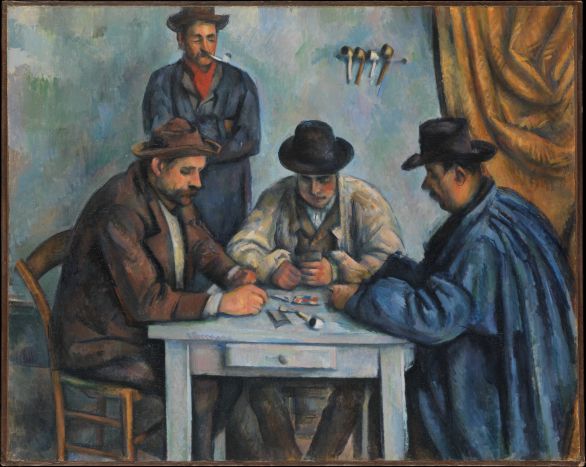
Paul Cézanne's The Card Players is part of a celebrated series of five paintings created between 1890 and 1895. The figures are modelled as solid, almost architectural forms, their bodies built from blocks of colour rather than expressive gesture.
Cézanne removes narrative tension entirely: there is no visible winner, no dramatic exchange, no sense of climax. Instead, the game becomes a quiet structure, a repetition of forms, pauses, and balances.
The game is presented as a timeless, meditative ritual embedded in rural life. For some of us, our first memory of our grandparents is them playing cards.
NFT Details
The Related Digital Assets
The contents of each NFT consists of two core digital components, both of which are available below. For a deeper understanding of how these assets function as an NFT, please refer to the Education section.
- The NFT Metadata: Contains all on-chain information about this asset, including the IPFS address of The Digital Image.
- The Digital Image: The associated visual content, also can be accessed through the IPFS.
We strongly advise NFT holders to securely store copies of the two files above. In the unlikely event that the files become unpinned from the IPFS network, pinning can be restored as long as the exact digital files are preserved.
Pricing Context
Buyout prices are based on the Reference Value of the original artwork, from which NFT pricing have been derived. Item offered as Digital Collectible. Resale not guaranteed. For more information on employed methodology and key considerations, please refer to our Pricing page.
Reference Value of Original Artwork (for context only): $300,000,000
Buyout price: 68,182 XRP
Where can I view this NFT
The NFT can be viewed and interacted with across several platforms:
- View an intuitive version of the NFT record on Bithomp.
- Inspect the raw transaction data directly on the live XRP Ledger.
- Buy, sell, or bid on this NFT via the leading XRPL marketplace xrp.cafe. Secondary-market liquidity is not guaranteed. NFTs are high-risk and may lose value.
Notes on mint
Minting was done through an XRP Ledger minting platform provided by Aesthetes, the popular XRPL NFT platform for contemporary artists.
Licencing
This work is believed to be in the public domain in the United Kingdom on the basis that the creator died more than 70 years ago, and no other known restrictions apply under applicable copyright law.
This work is believed to be in the public domain in the United States because it was published (or registered with the U.S. Copyright Office) before January 1, 1930.
Consistent with the position taken by the Wikimedia Foundation, we affirm that faithful digital reproductions of two-dimensional public domain artworks are themselves in the public domain.

To explore the full basis for this work's public domain designation, see the relevant entry on Wikimedia Commons.
For more information, please refer to Legal and Disclaimers.